
The Y2K38 Problem Is Real and Most Systems Are Not Ready for It
An explainer on the Unix timestamp overflow event on January 19, 2038 and why every developer writing date-handling code needs to understand it.
 By Muhammad Zeeshan~7 min read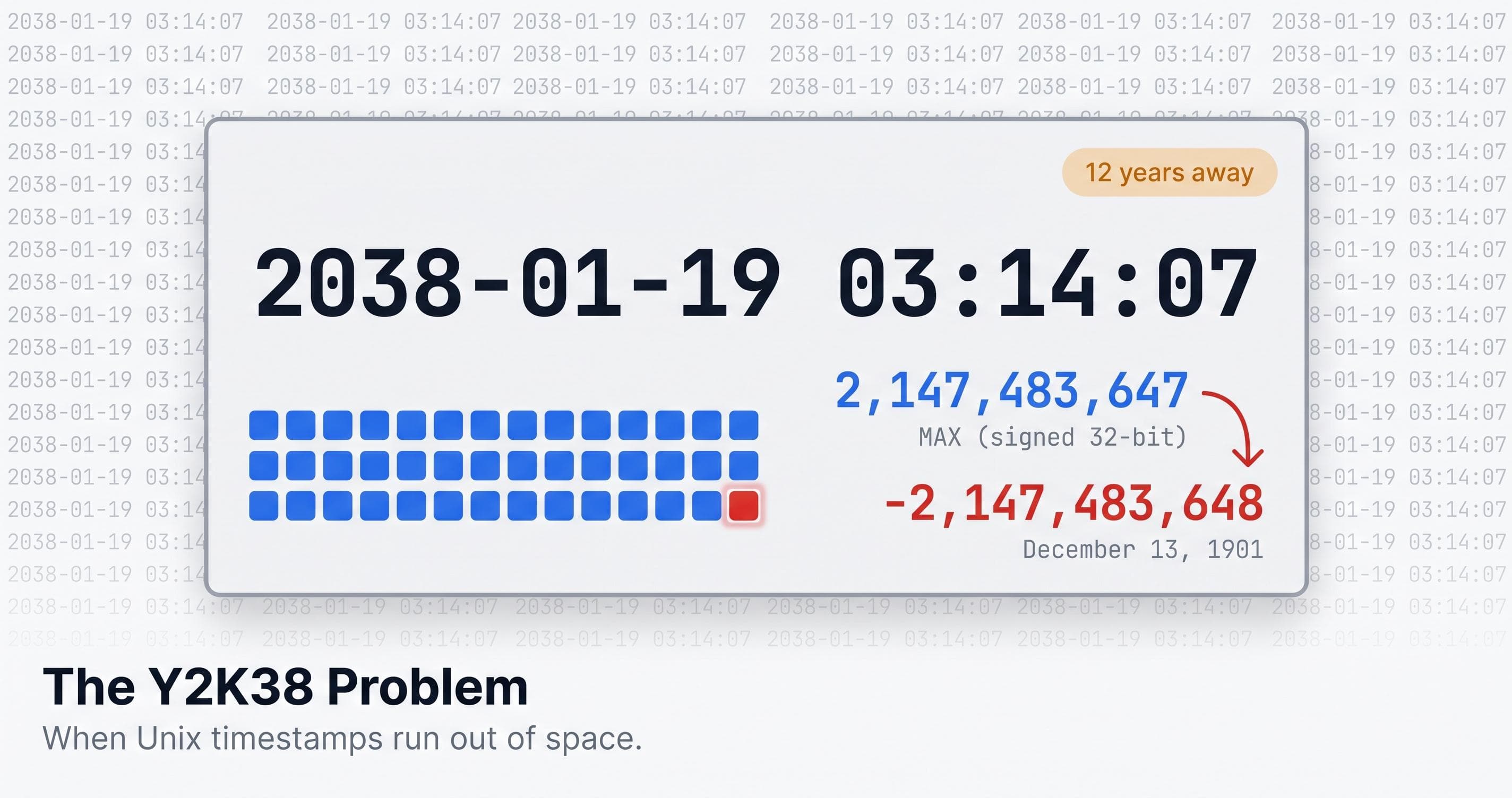
Mark the date. January 19, 2038. At 03:14:07 UTC, the count of seconds since January 1, 1970 will reach 2,147,483,647.
That's the maximum value of a signed 32-bit integer. At 03:14:08, systems still storing Unix timestamps as signed 32-bit integers will overflow to the most negative value a 32-bit integer can hold: negative 2,147,483,648. Interpreted as a Unix timestamp, that value is December 13, 1901.
In one second, time jumps backward 136 years.
This is the Year 2038 problem: Y2K38, the Unix Millennium Bug. Unlike Y2K, which was largely remediated before it hit, Y2K38 is a slower-moving and less visible problem. There's no global deadline pressure pushing organizations to audit their systems. The affected code often lives in firmware, embedded devices, legacy databases, and infrastructure built before 64-bit integers became standard.
Why January 1, 1970
Unix time counts seconds from a fixed reference point called the Unix epoch. The choice of January 1, 1970 was made by the original Unix developers at Bell Labs and was partly arbitrary. The system needed a starting point, and that date was recent enough to be practical while being early enough to predate the system itself.
Every Unix timestamp you encounter in a log file, API response, or database column is a count of seconds (or sometimes milliseconds) from that moment. A timestamp of 0 means midnight on January 1, 1970 in UTC. A timestamp of 86400 means exactly 24 hours later. Simple, timezone-neutral, unambiguous. That's why it became the universal format for representing moments in time in computing.
The 32-bit signed integer was the natural storage type in the early Unix era. 32 bits gives a range of negative 2,147,483,648 to 2,147,483,647. Starting from January 1, 1970, positive values represent times after the epoch and negative values represent times before it. The maximum positive value corresponds to 03:14:07 UTC on January 19, 2038.
When the kernel developers made this choice, 2038 was 68 years away. Someone else's problem. It's now 12 years away.
What Is Actually at Risk
The distinction between affected and unaffected systems comes down to one question: what data type stores the timestamp?
64-bit systems that store timestamps as 64-bit integers aren't affected. A 64-bit signed integer can represent timestamps up to the year 292,277,026,596. Not a problem any living person will see.
32-bit signed integer storage is where the risk sits. This category includes:
Embedded devices and firmware built on 32-bit architectures where the kernel or time library uses a 32-bit time_t type. Network equipment, industrial controllers, medical devices, and consumer electronics built before 64-bit embedded processors became standard all potentially fall here. Some of these can't be fixed with a software update if the hardware doesn't support 64-bit arithmetic.
Legacy database columns defined as INT rather than BIGINT for timestamp storage. A MySQL or PostgreSQL INT column holds 32 bits. Any application storing Unix timestamps in an INT column will produce incorrect results for timestamps past January 2038. The query succeeds. The data is wrong.
Compiled C and C++ code on 32-bit platforms where time_t is defined as int32_t. The C standard doesn't specify the size of time_t. On 32-bit Linux it has historically been a 32-bit signed integer. Code compiled for a 32-bit target and never recompiled for 64-bit still uses the old type size.
File systems with 32-bit timestamp fields. Some older file system formats store file modification times in 32-bit fields. FAT32, still widely used on removable media, has its own separate year-2107 overflow problem. Systems using FAT32 that also store Unix timestamps separately can be affected by Y2K38.
The Bugs That Happen Before 2038
Y2K38 is a specific overflow event. But timestamp handling produces bugs today. Most come from three common mistakes.
Mixing seconds and milliseconds. Unix timestamps are traditionally in seconds. JavaScript's Date.now() returns milliseconds. Many modern APIs return milliseconds. Many log formats use microseconds. A timestamp of 1,716,070,800 in seconds is May 19, 2024. The same value in milliseconds is January 20, 1970. Passing a millisecond timestamp to a function that expects seconds puts you 50 years in the past. Passing a second value to a function expecting milliseconds puts you 50 years in the future. Neither produces an error. Both produce plausible-looking dates that are wrong.
The most common symptom is records with dates in 1970, right at the Unix epoch, or dates in the 2050s and 2060s. If you see either in your data, timestamp unit mismatch is the first thing to check.
Assuming UTC when the timestamp is local. Unix timestamps are always UTC. They have no timezone. They represent an absolute moment. Problems start when a timestamp is generated from a local time without converting to UTC first, or when a timestamp is displayed by converting to UTC when the user expected local time.
The symptom is timestamps off by a fixed number of hours corresponding to the timezone offset. An event at 3:00 PM Eastern appears as 8:00 PM or 7:00 PM depending on daylight saving time. The fix: generate timestamps in UTC, store them in UTC, convert to local time only at the moment of display.
Clock skew between services. In distributed systems, each machine has its own clock. Even with NTP synchronization, clocks drift. A timestamp generated on one machine and compared against the current time on another can appear expired or in the future by tens of milliseconds to several seconds.
This becomes visible with JWTs and other short-lived tokens where the issuer generates exp based on the issuer's clock and the verifier checks it against the verifier's clock. Most implementations add 30 to 60 seconds of tolerance. The root cause is timestamps without guaranteed clock agreement.
Reading Timestamps Without a Script
The most common daily version of this problem is encountering a Unix timestamp in a log file, an API response, a database record, or a distributed trace and needing to know what moment in human time it refers to.
A timestamp like 1716070800 is meaningless without conversion. Writing a throwaway script, dropping into a REPL, or asking an assistant that might silently assume the wrong timezone all introduce unnecessary friction and potential for error.
The Unix Timestamp Converter converts between numeric timestamps and human-readable dates in both directions. It handles seconds and milliseconds automatically and shows UTC and local time side by side so you see both representations at once without doing mental offset arithmetic.
For diagnosing the milliseconds vs seconds confusion: paste the value, see if the resulting date looks plausible. A timestamp that produces a date in 1970 or in the 2060s is almost certainly the wrong unit. The converter makes that visible immediately, before you spend ten minutes inspecting the code that generated the value.
What to Do About Y2K38
For developers writing application code today, the path forward is clear.
Use 64-bit integers for all timestamp storage. In database schemas, use BIGINT for Unix timestamp columns, not INT. In application code, use language types that are 64-bit on your target platforms. In APIs, return timestamps as strings if you're not certain about numeric precision in all consumer environments.
Audit your database schema for INT timestamp columns. A query against your schema's column type definitions will show every column storing timestamps as 32-bit integers:
SELECT table_name, column_name, data_type FROM information_schema.columns WHERE data_type IN ('integer', 'int') AND (column_name ILIKE '%_at' OR column_name ILIKE '%timestamp%');If that turns into a migration spanning more than a couple of tables, run the generated ALTER TABLE batch through a SQL Formatter before you ship it. An unreadable multi-table migration is how a column gets missed. Migration to BIGINT is a straightforward column type change. Do it before those columns hold records that will ever be queried after January 2038.
Flag embedded and legacy systems. If your organization runs embedded devices, network equipment, or compiled systems on 32-bit architectures, identify which ones include timestamp handling and assess whether they can be updated. This is the harder problem. Some of it genuinely can't be fixed in software.
Think in UTC. Generate timestamps in UTC. Store timestamps in UTC. Convert to local time only at the moment of display. This doesn't prevent Y2K38 but eliminates the class of timezone-related timestamp bugs that affect systems today.
The overflow is 12 years away. The timestamp handling mistakes that cause bugs today are not. Both problems share the same root: insufficient care about how numbers representing moments in time are stored, transmitted, and interpreted.